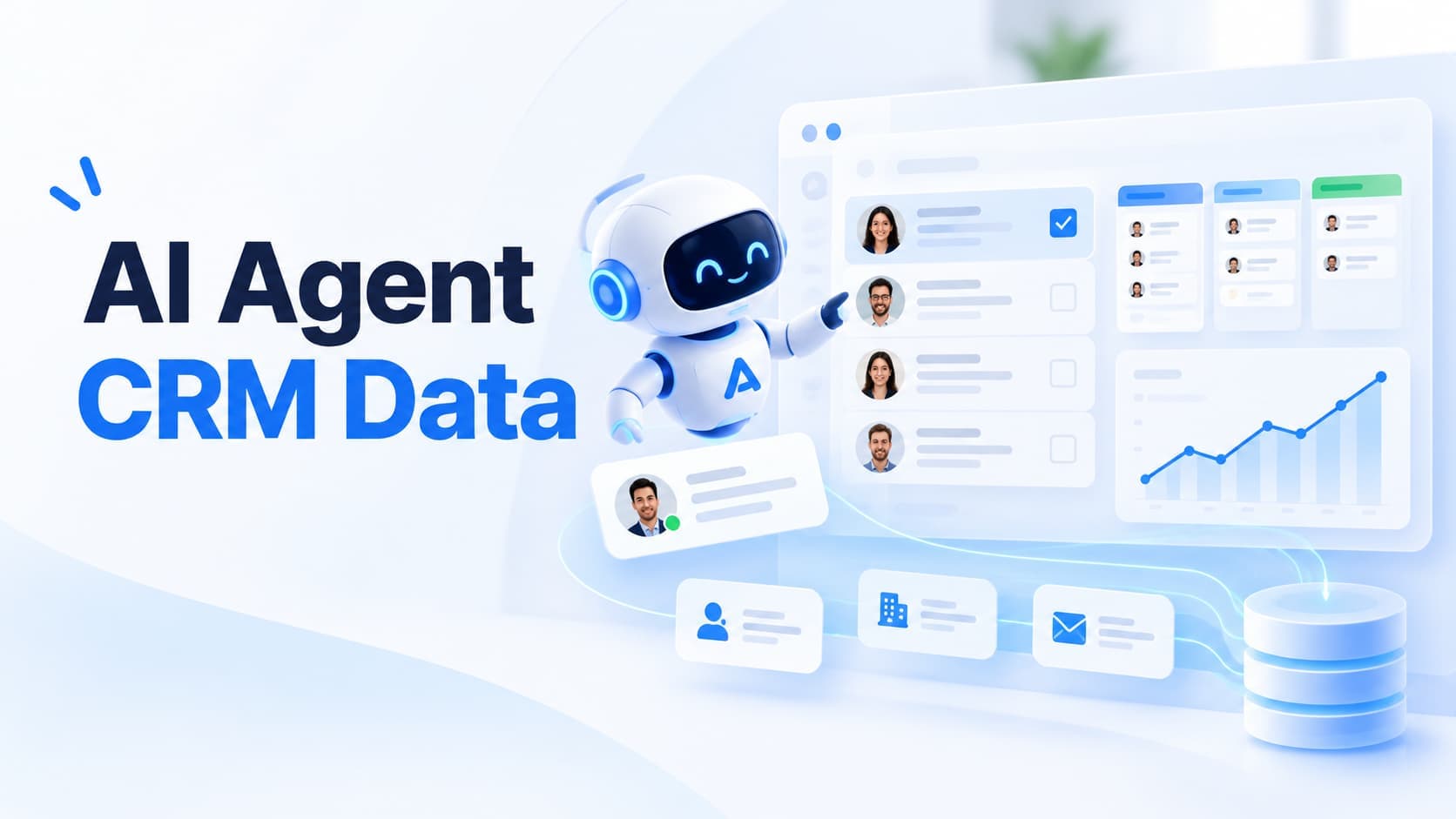
Companies are rushing to add AI agents to sales and CRM workflows. The awkward part is that an agent can only act on the data it can trust. Duplicate contacts, stale deal stages, and broken ownership do not disappear when AI arrives. They scale.
Lynka Team · October 8, 2026 · 15 min read · AI
Follow Lynka on Google
Get new articles in your preferred sources.
On this page
Everyone wants an AI agent in their CRM now. Fine. But there is a slightly embarrassing problem that nobody wants to put in the demo:
The CRM is full of garbage. Duplicates. Outdated numbers.
Six-month-old "Negotiating" deals that have since vanished. Leads that belong to people who have left the company. Companies with three slightly different spellings.
Notes that say
call him next week
with no idea who "him" is. We hook an agent to all of this and then complain that it is making bad decisions faster than a human? That is the part of agentic CRM that is hard to put in the brochure.
An AI agent does not magically improve the reality it is built upon. It inherits it. And once the agent has been unleashed, bad CRM data stops being an annoyance.
It becomes automation fuel.
The AI agent is not the source of truth
This is an inconvenient detail, but it is a fact. The agent can think. It can summarize.
It can decide what to do next. It may be able to send emails, update records, create tasks, research accounts or prepare reports. But when it needs to know who owns the lead, when the last conversation happened, whether the deal is still active, what the customer requested, or what price was quoted, it has to get those answers somewhere.
Most likely, the answers are in the CRM, the email system, the support desk, the ERP, the data warehouse or some combination thereof. If the underlying data is wrong, even an AI agent can make the wrong decision. Salesforce has an entire guidance note on the subject for Agentforce and Data 360.
In short, inconsistent formats, duplicates and other data-quality issues will reduce agent performance. Its example agent fails to process a refund because the date was not in the right format.
[Salesforce explains the connection between data quality and Agentforce here]
Meanwhile, HubSpot has devoted an entire track at its September 2026 UNBOUND conference to the topic. One of the talks is literally called Building the Data Foundation for Agentic AI with the subtitle Agents Are Only As Good As The Data They're Trained On.
[The talk is here]
Different vendors, same message: The agent is not the database. It is the thing that makes decisions with the database.
Bad data becomes more dangerous with AI
Before agents, bad CRM data was a nuisance. A salesperson might call the wrong number. A manager might forecast with last year's pipeline.
Marketing might email the same person twice. Finance might send an invoice that has already been paid. Annoying, but understandable.
Now give the agent permission to call customers, send emails, update records or route tickets. The same mistakes become far more damaging. Instead of one salesperson calling the wrong number, the entire team may be making wrong assumptions about the lead.
The agent may send the follow-up to the wrong person, prioritize a dead opportunity, or fail to notice a customer it needs to contact soon. Duplicates become much more expensive in an automated world. If the agent summarizes or acts on information from the wrong person, it could be wasting everyone's time.
A human salesperson may review a lead's file and decide it is too old to follow up. But if the agent uses the same information, it may send an auto-response anyway, believing it has enough context to handle the lead. The problem is not that the agent is "dumb", but that many companies are using it to make decisions that previously required human judgment.
That is why the phrase AI-ready data is so prevalent now. It sounds impressive, but it reflects a reality where companies are deploying increasingly autonomous systems without fundamentally changing the underlying databases. The phrase itself is almost a consulting euphemism for Can the machine act on this data without a person double-checking it first?
If the answer is no, the data is not ready for much autonomy.
Organizations are adopting agents faster than they are fixing the plumbing
According to BCG's 2026 AI-at-work research, 30% of respondents say AI agents are already embedded in their workflows, up from 13% the year before. Meanwhile, 50% say their organizations have already tested or piloted agents at work. At the same time, only 50% of respondents said their organizations have established clear governance practices for teams that include both humans and AI.
[BCG's report is here]
That is an astonishing disconnect. The agent is arriving, but the operating system around the agent is being invented as we speak. The same dynamic is at work with data.
Everyone is buying an agent. Nobody wants to spend time deduplicating 18,000 contacts. Guess which gets the bigger presentation to the C-suite.
What does AI-ready CRM data look like?
Let us forget the term for a second. A record that is fit for use by an AI agent should be:
recent (up-to-date),
consistent,
sufficiently complete,
well-connected to other relevant records and
governed in a way that makes sense for the agent to consume.
1. The information should be recent or up-to-date
A customer who changed companies two years ago should not be treated as if they still work at their old firm. A deal that was "Proposal Sent" in January should not be included in this month's forecast. A lead that belongs to a person who has left the company should not stay in that person's queue.
Freshness is important because it reduces the number of assumptions the agent has to make. Humans are not great at determining whether a piece of information is still valid, but machines are even worse. When we see a six-month-old field, we may think to ourselves Ah, this is probably out-of-date but that is not always the case.
Some records really do have a long lifespan. The machine has no way of knowing which is which, so it has to make an assumption.
2. The data should be consistent
If one system stores the date as 06/10/26 and another stores it as 10/06/26, which one is correct? If the company name is stored as Acme Ltd in one record, ACME Limited in another and Acme in a third, are they the same customer? Consistency is not always easy to achieve, especially across systems, but it is a prerequisite for automation.
Inconsistent data requires humans to step in and ask Are these really the same thing?
3. The record should be sufficiently complete for the task at hand
Not every field has to be filled. That would be unreasonable. But for the fields that matter, there should be values.
If you want an agent to qualify leads, you need to know the industry, geography, company size, need, source, contact information and recent activity. If half of those are missing, the agent has limited options: it can either stop or guess. You want fewer guesses than most AI demos suggest.
4. The record should be connected to other relevant records
A lead does not exist in a vacuum. To make decisions about the lead, the agent may need to consider the related company, contacts, deal, activities, email, quote, invoice, support requests and campaign, if any. This is why record structure is so important in a CRM.
When the agent is asked, “Tell me about this customer,” it needs more than the lead's name and email. It needs the related records, too.
5. The record should have an owner or steward who understands its nuances
Someone has to be able to answer the questions no one else can. What does qualified really mean? When does the deal become lost?
Who updates the customer's status? What happens when a salesperson leaves? Who decides which fields take priority if two systems disagree?
Those are all data-governance questions, and there should be clear answers. An AI agent cannot solve an organizational disagreement by becoming more intelligent.
Duplicate contacts are not what they used to be
Imagine your CRM has two records for Michael Mensah with the same email address: michael@company.com One has an active opportunity with an $18,000 value and a conversation that happened yesterday. The other has a deal that is no longer active and a conversation that occurred eight months ago. A human salesperson may realize that these are two versions of the same customer.
An agent may not. Now ask the agent to Find all customers we have not spoken to in 90 days and send them a re-engagement email. Congratulations: Michael Mensah may get a very enthusiastic email asking if he remembers your company approximately 17 hours after speaking to sales.
This is why preventing duplicates becomes exponentially more important as agents gain autonomy. The agent is not being "stupid". The database told it two different stories, and it acted on both.
Stale deal stages are even worse
CRM pipelines are full of polite lies. Deals stay open because no one wants to close them. Forecast numbers look better that way.
Old opportunities continue to be "Negotiation" long after any serious conversation.
When managers ask the agent, “Which deals should we prioritize this week?” the agent sees Negotiation $50,000 high priority and quite reasonably decides “This one.” The salesperson knows the deal is stale and that the buyer has not been seen since March, but the system does not.
This is the danger of automatedCRM: The machine faithfully reflects the data, but the data does not always reflect reality.
AI will make CRM hygiene more valuable, not less
There was an era when vendors hoped structured data would be less important as more AIs were introduced to the workplace. The model can read emails, after all. It can search the database.
It can infer what happened if there is no explicit information. Why bother with CRM hygiene? Why keep fields up-to-date?
Why maintain pipelines? Why worry about record owners? Because inference is valuable, but deterministic business state is even more valuable.
Consider
Pipeline stage
You do not want an AI model to independently invent new stages for your deals every time it reads the account. Consider Invoice paid That should be populated from an external accounting system, not guessed from an email that says We sorted this out yesterday Consider Lead owner That should be explicit. Consider
Customer status
Same thing. An agent is great at interpreting unstructured information, but it is not a reason to eliminate fundamental facts the business needs.
The best AI CRM architecture puts facts behind judgment
This is where a lot of agent implementations go sideways. Some information should be deterministic in nature, such as
customer ID
invoice amount
payment status
deal owner
activity date
product SKU
currency
permission
account status
The agent should know these, too, but they are facts that should not be debated or inferred. Then the model can reason on top of those facts: This deal has not had any activity for 18 days and is still in negotiation, so it may be stale. That is useful, but it does not overwrite the accounting system or change the fundamental facts of the sale.
The pattern should always be:
Systems store facts.
Agents reason about facts.
Humans handle important ambiguity.
That is much safer than agent vibes all the way down.
What should you clean before adding an AI agent?
Do not start with a six-month master-data-cleansing effort if you do not need it. Focus on the record or workflow the agent touches first. If the agent will work on sales follow-up, inspect:
Contact duplicates
Can the same person appear more than once? How are duplicates handled? What record takes precedence?
Ownership
Does every lead and deal have an owner? What happens if ownership changes?
Pipeline stages
Are open deals really open? Do stages mean the same thing to everyone?
Activity history
Can the agent tell when the customer was last contacted? Are important communications captured?
Source
Do you know where the lead came from? Or is everything marked "Other" because no one wants to put in the work?
Required context
What information does the agent need to make the decision you are asking it to make? Clean that first. Do not spend six months fixing fields the agent never looks at.
A simple test for AI-ready CRM records
Take ten real records, not demo data. For each one, ask these questions:
Who is this? Which company do they belong to? Who owns the relationship?
What happened last? What stage are they in? What is supposed to happen next?
Are there duplicates? Is the contact information valid? Would I trust an automated action based on this record?
If the answer to the last question is "absolutely not" seven times out of ten, your next step should not be to buy a smarter model. It should be to fix the database.
Do not confuse more data with better data
This is one of those ideas that sounds intelligent but is actually a terrible idea. Companies connect everything to the agent: CRM, email, Slack, support tickets, billing, documents, calendars, phone calls, website activity, product analytics and so on. They assume the agent is "smarter" now that it has more context.
Sometimes it is, but it depends on what the additional context contains. More sources only help if the system can answer Which source is more authoritative? How recent is the information?
Which identity maps to which customer? Which fields are trustworthy? What permissions apply?
Otherwise, the model has to spend its intelligence trying to decipher your internal warring factions. That is not a good use of its talents.
Give the agent uncertainty
One of the best things you can do is to give the model an "I do not know" option. For example:
The lead's industry is missing. I cannot qualify this reliably. Good.
Two possible customer records match this email. Please tell me which one is correct. Good.
The deal's status has not been updated in 120 days. I would not use it for the forecast without human input. Excellent.
The most dangerous agents are not the ones that ask for help. They are the ones that pretend to act on information they do not have.
Human review should be designed, not improvised
"Human in the loop" has become a popular phrase in enterprise software, but it rarely comes with specifics. Where is the human? What does the human review?
When does the human act? Which actions can proceed without human input? Those are product-design questions.
For a CRM agent, a possible ladder might look like this:
Low risk
Summarize account history Flag stale records Suggest duplicates Draft follow-up Recommend next action
Medium risk
Update non-critical fields Assign a task Move a lead between early stages in a pipeline Enrich company information
High risk
Send external messages Update pricing Mark a deal won or lost Modify an invoice Delete customer data Make commitments to the customer The higher up the ladder you go, the more thought should go into approval and review processes.
The metric should be corrected work, not generated work
AI agents are amazing, but do not be fooled into thinking quantity equals quality. Sure, the agent may update 5,000 records, but how many of those needed correction? A sales agent that updates 5,000 records and renders 800 unusable is not as impressive as it sounds.
Focus on the records that were useful, the follow-ups that led to responses, the duplicates that were correctly identified, the stale opportunities that were removed, the time saved with automation, the errors avoided, the necessary human review. Volume is not value. Automation is not efficiency.
What this means for CRM products
CRM software is about to get much more important. That sounds counterintuitive: If the AI can talk to everyone, why do we need CRM? The reason is simple: Someone has to preserve the commercial truth.
Who is the customer? What happened? What is open?
What is owed? Who owns it? What happens next?
The interface to all of that may change, and humans may click around less, but the system of record will become more important, not less. Recent enterprise coverage has noted the same trend: The so-called "SaaS apocalypse" is less of a sign that software is dying and more of a signal that AI is becoming the new interface to the systems that hold business data. [Business Insider has an article on the topic here]
Where Lynka fits
Lynka reflects the same philosophy: It is built around the business relationships AI agents eventually need to understand: leads, companies, deals, activities, quotes, invoices and payments. The point is not that adding AI suddenly makes those records optional. The opposite: If you plan to layer AI on top of a sales process, the quality of those records suddenly becomes much more important.
A clean CRM gives the agent something useful to reason about. A messy CRM gives it confidence-shaped chaos.
[Explore Lynka Sales]
[See Lynka Lead Generation]
[View Lynka pricing]
The uncomfortable conclusion
Everyone wants the agent. Nobody wants the cleanup. But the cleanup is the product.
An AI agent can only be as reliable as the reality your systems expose to it. If your CRM says the wrong person owns the lead, the deal is still active, the customer has not been contacted, and the invoice is unpaid, the model may do an excellent job acting on information that was never true. That is worse than a "dumb" CRM.
At least the dumb CRM waits for you to click something. The agent does not. Before asking how intelligent your AI is, ask a less exciting question: Can it trust your data?
If the answer is no, start there.
FAQ
AI agents use CRM data to understand leads, opportunities, ownership, activity history and business state. Duplicate, stale or incomplete records can lead to incorrect recommendations or actions by the agent.
AI-ready CRM data has sufficient freshness, consistency, completeness, connection and governance to support an autonomous agent.
AI can help with deduplication, field normalization, record enrichment and other tasks, but deterministic rules and human review are often needed for identity resolution, ownership, accounting and other fields.
Important fields usually include contact details, company, lead owner, deal owner, stage, activity history, source, qualification information and next steps, depending on the agent's tasks.
For low-value fields, maybe, but higher-risk actions should have stronger governance and human review.
Not really. Better AI can reduce the need to manually navigate the CRM, but the records inside it still matter for automation, analytics and accountability.
HubSpot UNBOUND 2026: Building the Data Foundation for Agentic AI (here )
Salesforce Trailhead: Understanding Data 360's Role in Agentforce (here )
Salesforce: Is Your Data Ready for Agents? (here )
BCG: AI at Work, Why Strategy Matters More Than Tools (here )
Business Insider: AI Agents Are Reshaping Enterprise Software (here )
AI AgentsCRMData QualitySalesBusiness AIAutomation
Keep the next step connected
Find leads and manage them in one place with Lynka.
Bring prospecting, follow-up, sales and the work after the sale into one connected workspace.