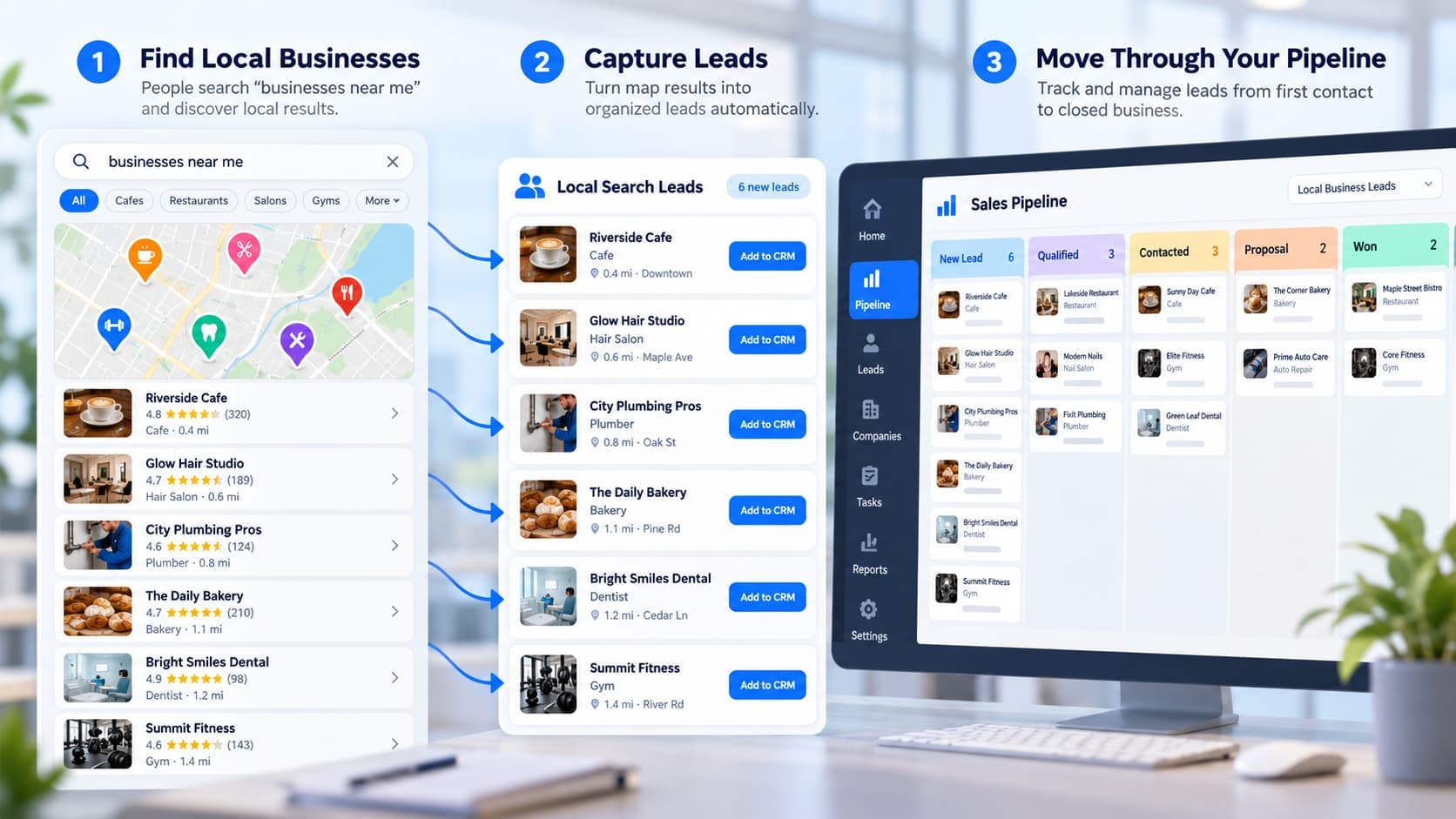
Local Lead Generation in 2026: How to Find Customers Without Wasting Money
Local lead generation is not just running ads or ranking on Google Maps. The real work is finding the right prospects, qualifying them and following up before they disappear.
By Lynka Team
Local Lead Generation in 2026: How to Find Customers Without Wasting Money
Most local businesses do not have a lead generation problem.
They have three smaller problems wearing one trench coat.
They do not know where to find the right prospects.
They do not know which prospects are worth contacting.
And when someone finally shows interest, follow-up is inconsistent.
So they buy ads.
Or they hire an agency.
Or they scrape a list.
Or somebody says:
"You need more SEO."
Then three months later they still have the same problem, except now there is a monthly invoice attached to it.
That is why local lead generation needs to be understood as a system, not a tactic.
The goal is not to collect names.
The goal is to consistently find people or businesses in a specific area who are likely to need what you sell, then move them toward a real conversation.
That process usually involves five things:
finding demand
finding prospects
qualifying them
contacting them
following up properly
Miss one of those and the whole system gets weaker.
What is local lead generation?
Local lead generation is the process of finding and attracting potential customers within a defined geographic area.
That could mean:
homeowners near a plumbing company
restaurants within a city
businesses within a sales territory
property owners in a specific region
clinics within 20 kilometers
companies in one industrial zone
customers searching for a nearby service
The word local matters because it changes how you generate leads.
A national software company might target anyone in the United States.
A roofing company usually cares whether the person lives within driving distance.
A business selling POS systems may care about restaurants in Accra.
A web agency might care about companies in Dar es Salaam.
A cleaning company may only serve certain neighborhoods.
Your total market is smaller.
But that can actually make prospecting easier because geography gives you a useful filter.
Local lead generation is not the same as local marketing
These terms overlap, but they are not identical.
Local marketing includes anything that increases awareness in a geographic area.
That could be:
billboards
sponsorships
branded vehicles
Lead GenerationLocal BusinessSmall BusinessSalesProspectingCRM
Follow Lynka on Google
Get Lynka's practical CRM and business software articles in your preferred sources.
Keep the next step connected
Find leads and manage them in one place with Lynka.
Bring prospecting, follow-up, sales and the work after the sale into one connected workspace.
radio
Lead generation is narrower.
A lead is somebody you can potentially move toward a sale.
That usually means you have at least some identifiable signal:
name
phone number
email
company
enquiry
booked call
submitted form
known business profile
explicit interest
A thousand people seeing your sign is marketing.
Ten people requesting a quote is lead generation.
Both can matter.
But do not confuse visibility with pipeline.
The biggest local lead generation mistake
The most common mistake is assuming the hard part is sending the message.
It often is not.
The hard part is knowing who should receive the message in the first place.
A recent Reddit discussion about local lead generation described exactly this problem: hours spent moving between Google Maps, websites and spreadsheets, filtering duplicates, closed businesses and incomplete records before outreach even begins. Reddit
That is the part nobody puts in screenshots.
The glamorous version of prospecting looks like:
100 businesses found
40 replies
12 meetings
Reality often looks more like:
100 listings found
17 permanently closed
13 duplicates
22 irrelevant
19 have no usable website
11 have no obvious contact information
9 are clearly too small
6 are already customers of a competitor
3 are worth contacting
Welcome to lead generation.
A good local lead is not just "a business nearby"
This distinction matters enormously.
Suppose you sell websites to restaurants.
You search Google Maps for:
restaurants in Accra
You find 500.
Congratulations.
You have not generated 500 leads.
You have generated 500 businesses.
A lead becomes interesting when there is some reason the business might need you.
For example:
no website
broken website
website not mobile friendly
no online ordering
poor reviews
outdated menu
missing booking flow
bad Google Business Profile
no clear contact form
inconsistent branding
newly opened
expanding
hiring
running ads to a weak landing page
That is the difference between a list and a prospect list.
One contains names.
The other contains reasons.
The best local lead generation starts with a problem
This is the easiest way to make prospecting better.
Do not start with:
"Who can I sell to?"
Start with:
"Who obviously has the problem I solve?"
If you sell CRM software, you might look for businesses that:
receive lots of enquiries
have multiple salespeople
rely heavily on WhatsApp
use spreadsheets
have no obvious lead system
run ads
depend on follow-up
have long sales cycles
If you sell websites:
no website
slow website
broken mobile layout
outdated design
no conversion path
If you sell bookkeeping:
growing company
multiple branches
frequent hiring
messy invoicing
visible expansion
The clearer the problem signal, the easier the outreach becomes.
Because now you do not need to invent a reason to contact them.
The reason already exists.
Where do local leads come from?
There are two broad categories.
Inbound local lead generation
People find you.
Examples:
Google Search
Google Maps
Google Business Profile
Local Services Ads
website forms
Meta ads
referrals
social media
local content
community groups
Outbound local lead generation
You find them.
Examples:
Google Maps prospecting
local directories
industry directories
cold email
cold calling
LinkedIn
Facebook business pages
Instagram
manual research
public business databases
Neither approach is automatically better.
Inbound tends to capture people already looking.
Outbound lets you reach businesses before they search.
Many strong local sales systems use both.
Google Maps is one of the best prospecting databases nobody calls a database
For local B2B prospecting, Google Maps is extremely useful.
Search:
dentists in Kumasi
restaurants in Dar es Salaam
real estate agencies in Beirut
salons in Accra
You immediately get:
business name
category
location
phone number
website
reviews
opening hours
photos
That is a lot of commercial information.
More importantly, you can inspect the business.
Does the website work?
Are reviews recent?
Do they look active?
Does the contact information match?
Do they appear established?
Do they have obvious weaknesses?
The downside is that doing this manually becomes painful quickly.
This is why list-building is increasingly its own workflow rather than a simple search task.
Recent 2026 local lead generation guides are now explicitly treating map data, enrichment and qualification as separate stages rather than pretending that scraping a directory is enough. LeadZipp
Local SEO generates a different kind of lead
Outbound prospecting finds businesses you want.
Local SEO helps customers find you.
For service businesses, the search often looks like:
plumber near me
accountant Accra
dentist East Legon
real estate agent Beirut
roof repair near me
These searches are powerful because intent is already visible.
The person is not casually reading about plumbing.
Their ceiling may currently be leaking.
That urgency matters.
Google itself describes local lead generation through Search and Local Services Ads as a way to reach nearby customers actively looking for services. Google
Google Business Profile matters more than many websites admit
For local service businesses, your Google Business Profile can sometimes generate more commercial value than half your marketing stack.
People can see:
location
reviews
photos
opening hours
phone number
website
directions
service information
And importantly, they can compare you with nearby competitors immediately.
That makes reviews particularly important.
A local customer choosing between:
4.8 stars, 340 reviews
and
3.9 stars, 17 reviews
is not making a purely rational statistical decision.
They are making a trust decision.
The map result is part directory, part reputation system, part conversion page.
Reviews are lead generation
This is something businesses often put in the wrong department.
Reviews are treated as:
"Nice reputation thing."
They are more than that.
A strong review profile can affect whether a person becomes a lead at all.
Imagine two electricians.
Same location.
Similar price.
Similar website.
One has 180 strong reviews.
The other has 11.
Which one gets called first?
The answer will not always be the same.
But reviews clearly influence trust.
So asking satisfied customers for reviews is not separate from lead generation.
It is part of it.
Referrals are still embarrassingly effective
Marketing technology has become extremely advanced.
People still ask:
"Do you know somebody good?"
That is difficult for software companies to make exciting because there is no dashboard involved.
But referrals often produce high-trust leads.
A referred prospect begins with something paid advertising has to work hard to create:
credibility.
The mistake is treating referrals as luck.
You can create a process.
After successful work:
ask for a review
ask for a referral
make it easy to share your details
stay in touch with previous customers
maintain partner relationships
A boring referral system can outperform an exciting advertising experiment.
Paid ads are fast, but expensive mistakes happen faster
Paid advertising has one major advantage.
Speed.
You can launch a campaign and start receiving traffic quickly.
That makes Google Ads, Local Services Ads and Meta useful when you need demand now.
The problem is that ads amplify whatever is underneath them.
Strong offer + strong targeting + strong landing page:
more leads.
Weak offer + bad targeting + bad landing page:
faster waste.
Recent discussions from people exploring local lead generation repeatedly flag the same issue: local service categories can become expensive quickly, particularly in competitive trades. Reddit
Ads are not broken.
But they are very efficient at proving that your funnel is broken.
Your landing page has one job
If someone searches for:
emergency plumber near me
and lands on your website, they probably do not want:
Our Story
Our Mission
Our Values
Meet the Team
They want:
Can you fix this?
Do you serve my area?
How do I contact you?
A local landing page should make those answers obvious.
Useful elements include:
clear service
service area
strong contact option
reviews
proof
response expectation
relevant photos
simple form
phone number
trust signals
Do not make someone solve a puzzle to become a lead.
The form should not feel like applying for citizenship
This is another common mistake.
First name.
Last name.
Email.
Phone.
Company.
Address.
Industry.
Budget.
Number of employees.
Mother's maiden name.
Blood type.
Annual revenue.
How did you hear about us?
Please describe your entire problem in 500 words.
All because they wanted a quote.
Forms need enough information to qualify a lead.
Not enough information to write their biography.
Every additional required field introduces friction.
Use what you genuinely need.
Speed matters after the lead arrives
There is something absurd about spending money to generate a lead and then waiting two days to contact them.
Yet businesses do this constantly.
A new enquiry arrives.
Nobody owns it.
Someone thinks Sarah will respond.
Sarah thinks Michael is handling it.
Michael is on leave.
The lead contacts a competitor.
Marketing says:
"We need more leads."
No.
You needed to answer the ones you had.
This is where lead generation becomes CRM.
Lead generation without CRM becomes archaeology
At low volume, you can manage leads almost anywhere.
WhatsApp.
Notebook.
Spreadsheet.
Email.
Memory.
Then volume increases.
Now you are searching:
"I know somebody asked about this last month..."
That is archaeology.
A lead generation system needs somewhere for leads to go.
At minimum, you need to know:
who the lead is
where they came from
who owns them
whether they were contacted
whether they are qualified
what happened
what should happen next
Otherwise you are generating names faster than you can lose them.
Qualification matters more than quantity
Suppose Campaign A generates 100 leads.
Campaign B generates 25.
Which campaign is better?
No idea.
Now suppose:
Campaign A:
100 leads
8 qualified
1 customer
Campaign B:
25 leads
15 qualified
6 customers
Different story.
This is why lead volume is such a dangerous vanity metric.
The important numbers are further down the funnel.
For example:
Lead → Contacted → Qualified → Opportunity → Customer
You should know where the drop happens.
What makes a local lead qualified?
That depends on the business.
For a home service company:
inside service area
needs relevant service
realistic timing
valid contact details
For B2B:
correct industry
relevant company size
geographic fit
identifiable problem
decision-maker access
reasonable potential value
For real estate:
budget
area
timeframe
financing
intent
The point is to stop treating every name equally.
Some leads deserve immediate attention.
Some deserve nurturing.
Some deserve absolutely nothing.
That is fine.
Bad leads are expensive even when they are free
Suppose you download 5,000 business contacts.
Cost:
$0.
Sounds excellent.
Then your salesperson spends 30 hours working through:
dead emails
closed businesses
duplicates
irrelevant companies
wrong industries
wrong locations
generic inboxes
Was the list free?
Technically.
Was it cheap?
No.
Your team's time is part of acquisition cost.
That is why better lead generation increasingly focuses on relevance before volume.
Do not buy local lead lists blindly
Purchased lists can work.
They can also be awful.
Before relying on one, understand:
how recently it was updated
where the data comes from
whether businesses are verified
whether contacts are role-based or personal
whether duplicates are removed
whether geography is accurate
whether your intended use complies with applicable laws
A spreadsheet containing 20,000 rows is not automatically an asset.
Sometimes it is just a large spreadsheet.
The best local outreach starts with evidence
This:
Hi, we help businesses grow using cutting-edge digital solutions.
is not evidence.
This is:
I noticed your booking page returns an error on mobile.
Or:
Your Google listing links to a domain that no longer loads.
Or:
I saw you're running ads, but the landing page doesn't have a clear quote form.
Or:
You have strong reviews but no website linked from your profile.
That is why manual research can outperform mass personalization.
You are not pretending to know the prospect.
You found something real.
Personalization does not mean writing their company name six times
Modern cold outreach has accidentally made personalization ridiculous.
Hi Michael,
I noticed Michael Plumbing is a plumbing company.
As the owner of Michael Plumbing, you probably care about plumbing customers.
Remarkable research.
Actual personalization means the message would not make sense if sent to another business.
For example:
Your Google profile has 146 reviews, but the website button currently opens a parked domain. You may be losing people who check you before calling.
That is specific.
AI can help local prospecting, but do not let it hallucinate your sales pitch
AI is useful for:
researching businesses
summarizing websites
categorizing prospects
extracting information
identifying signals
drafting messages
prioritizing lists
What it should not do is invent observations.
If AI tells you:
"I noticed your booking process is difficult."
and nobody actually checked the booking process, you are now automating lying.
Not ideal.
Use AI to process real evidence faster.
Do not use it to fabricate evidence at scale.
How to build a local prospect list
Here is a simple workflow.
Step 1: Pick one market
Bad:
small businesses
Better:
restaurants
Better again:
independent restaurants in Dar es Salaam
Specificity makes qualification easier.
Step 2: Define the problem signal
Suppose you sell websites.
Your signals might be:
no website
dead website
not mobile friendly
outdated
no ordering
missing SSL
no obvious contact option
Step 3: Search
Use:
Google Maps
Google Search
directories
social platforms
industry associations
Step 4: Verify
Check:
active business
correct location
correct category
valid website
valid contact information
actual problem
Step 5: Prioritize
Do not contact everybody equally.
A business with:
strong reviews
active social accounts
bad website
clear demand
may be much more interesting than:
no reviews
no activity
closed-looking location
no obvious demand
Step 6: Add to CRM
Record:
company
contact
location
problem signal
source
priority
next action
Now you have a sales list.
Not just rows.
How Lynka approaches this
This is the part directly relevant to what we are building.
Traditional CRM software usually begins after you already have a lead.
The workflow is:
Find prospect somewhere else → copy to spreadsheet → import → CRM
Lynka's Lead Generation is designed to shorten that gap.
You search using criteria such as location and industry, generate prospects, then work with the useful ones inside the CRM instead of leaving the result as a disconnected list.
The important part is not generating thousands of names.
It is getting from:
possible business
to
relevant prospect
to
qualified lead
to
deal
without losing the context along the way.
Local lead generation example: web agency
Suppose a small web agency wants restaurant clients in one city.
Bad approach
Scrape 3,000 restaurants.
Send:
"We create high-converting digital experiences."
Wait.
Better approach
Find 100 established restaurants.
Check:
website exists?
site works?
mobile layout?
online menu?
booking?
ordering?
domain valid?
reviews?
Now identify 20 with obvious issues.
For example:
Restaurant A
4.7 stars
320 reviews
active Instagram
website broken
That is interesting.
The restaurant clearly has customers.
It clearly cares about online presence.
And there is a visible problem.
Now the outreach writes itself.
Local lead generation example: accountant
An accountant looking for business clients could target:
newly incorporated companies
businesses expanding locations
growing retailers
companies hiring finance staff
businesses with multiple branches
Again, the useful signal is not:
company exists
It is:
company may have increasing accounting complexity
That is better prospecting.
Local lead generation example: CRM software
Suppose we are prospecting for a CRM.
A solo barber probably does not need a serious CRM.
A ten-person real estate agency receiving enquiries from several sources might.
So useful signals include:
multiple salespeople
lead-driven business
advertising activity
long follow-up cycle
multiple locations
high-value transactions
visible growth
Lead generation improves when you understand who should not become a lead.
How much should local lead generation cost?
There is no honest universal number.
Cost varies massively by:
industry
country
city
competition
channel
lead definition
lead quality
conversion rate
A plumber in London and a graphic designer in Kumasi do not live in the same acquisition market.
Ignore articles that give one magical cost-per-lead number without context.
Instead calculate your own economics.
Suppose:
Ad spend: $1,000
Leads: 40
Cost per lead:
$25
But only 10 are qualified.
Cost per qualified lead:
$100
Two become customers.
Cost per customer:
$500
If each customer generates $4,000 in gross profit, excellent.
If each generates $200, terrible.
Cost per lead alone tells you almost nothing.
The metric that matters: cost per customer
Businesses love measuring:
impressions
clicks
visitors
leads
Eventually, however, somebody has to pay you.
A useful funnel looks like:
Traffic → Lead → Qualified → Opportunity → Customer
Measure each stage.
Then you can diagnose the problem.
Lots of traffic, few leads?
Conversion problem.
Lots of leads, few qualified?
Targeting problem.
Lots of qualified leads, few sales?
Sales problem.
Lots of sales, terrible margin?
Business model problem.
This is far more useful than saying:
"Marketing isn't working."
How fast should you contact a local lead?
As fast as is reasonable for your business and channel.
A person requesting emergency plumbing does not want a response next Tuesday.
A company researching accounting software may not require a call in thirty seconds.
Intent determines urgency.
The important thing is having a process.
For example:
High-intent inbound
respond quickly.
Normal enquiry
same working day.
Outbound prospect
scheduled sequence.
Long-term prospect
future activity.
CRM makes those differences manageable.
Follow-up is where a lot of lead generation quietly dies
A prospect does not reply.
The salesperson marks them mentally as:
Not interested.
Maybe.
Or maybe:
busy
travelling
missed email
forgot
not ready yet
needs approval
timing is wrong
Following up forever is annoying.
Following up once is often insufficient.
The right cadence depends on channel and business.
But you should have one.
"Whenever I remember" is not a cadence.
Local lead generation and CRM should be one system
Marketing cares about:
Where did the lead come from?
Sales cares about:
What happens now?
Management cares about:
Did we make money?
Those should not live in completely separate worlds.
A CRM gives the business a way to connect:
source → lead → qualification → opportunity → revenue
That creates feedback.
Maybe Google Ads generates many leads but poor customers.
Maybe referrals generate fewer leads but excellent customers.
Maybe outbound generates the strongest deals.
Now you can decide intelligently.
Seven local lead generation mistakes
Targeting everybody
Broad target means generic message.
Generic message means weak relevance.
Caring about list size
10,000 terrible contacts are not better than 100 relevant prospects.
Buying stale data
Old business data wastes sales time and damages outreach.
Ignoring follow-up
Generating a lead and forgetting it is surprisingly common.
Measuring only leads
Qualified leads and customers matter more.
Using AI to fake personalization
People can tell.
And even when they cannot, fake observations eventually create awkward conversations.
Having no CRM process
If the system after lead generation is:
"Put it in the sheet."
you may have simply moved the chaos one column to the right.
A simple local lead generation system for a small business
You do not need seventeen tools.
Start with:
Find
Google, Maps, referrals, ads or prospecting.
Capture
Name, company, contact information, source.
Qualify
Is this actually a fit?
Assign
Who owns the lead?
Follow up
What happens next and when?
Track
Did it become an opportunity?
Measure
Did it become revenue?
That is enough to build a real system.
Improve it when the volume forces you to.
Local lead generation is mostly about wasting less
That may be the least exciting conclusion possible.
It is also the most useful.
The goal is not always:
More leads.
Sometimes the better goal is:
fewer bad leads
faster follow-up
better qualification
cleaner data
clear ownership
better conversion
A company receiving 50 relevant leads and handling them properly can outperform one collecting 500 random contacts.
So before spending more money trying to fill the top of your funnel, look at what happens to the leads you already have.
You may discover that the leak is not at the top.
It is everywhere underneath it.
Explore Lynka Lead Generation →See how Lynka manages the sales pipeline →View pricing →
Frequently Asked Questions
What is local lead generation?
Local lead generation is the process of finding or attracting potential customers within a specific geographic area and converting them into identifiable prospects for a business.
How do local businesses generate leads?
Common channels include Google Search, Google Maps, Google Business Profile, referrals, local SEO, paid advertising, social media, directories and outbound prospecting.
What is the best way to generate local leads?
There is no universal best channel. High-intent search can work well for services people actively search for, while outbound prospecting can work well when you can identify businesses with a specific problem. The best method depends on the market and sales process.
How do I generate local business leads for free?
Free methods include Google Business Profile optimization, referrals, community participation, manual Google Maps prospecting, organic social media, local SEO and direct outreach. They may not require advertising spend, but they still require time.
Is Google Maps good for lead generation?
Yes, particularly for local B2B prospecting. Maps can provide business names, categories, locations, reviews, websites and contact details that can be used to research and qualify prospects.
What is the difference between local lead generation and local SEO?
Local SEO aims to improve visibility when nearby customers search for a business or service. Local lead generation includes SEO but also covers paid ads, referrals, outbound prospecting, directories, social media and other channels that produce prospects.
How do I qualify a local lead?
Qualification usually considers geography, need, timing, business fit, potential value and whether the person or company can realistically buy what you sell.
Should small businesses buy lead lists?
Sometimes, but list quality matters more than size. Businesses should understand where the data came from, how recently it was verified, whether contacts are relevant and whether using the data complies with applicable laws.
Can AI generate local leads?
AI can help research, categorize, enrich and prioritize prospects, and can assist with outreach. It still needs reliable underlying business data and should not invent personalization or qualification signals.
Why do local leads fail to convert?
Common reasons include poor targeting, slow response, weak qualification, inconsistent follow-up, unclear ownership, and targeting people who were never a strong fit.
Do I need a CRM for local lead generation?
At low volume, leads can be managed manually. As volume grows, a CRM becomes useful for tracking source, ownership, qualification, activities, follow-up and sales opportunities.
What is the difference between a lead and a prospect?
A lead is a potential customer that has entered your sales process or been identified as potentially relevant. A prospect is usually a lead that has been researched or qualified enough to justify active sales attention.
Free CRM software can be enough for a solo real estate agent, but contact limits, missing automation and weak follow-up tools can become expensive quickly. Here is what to look for before choosing one.