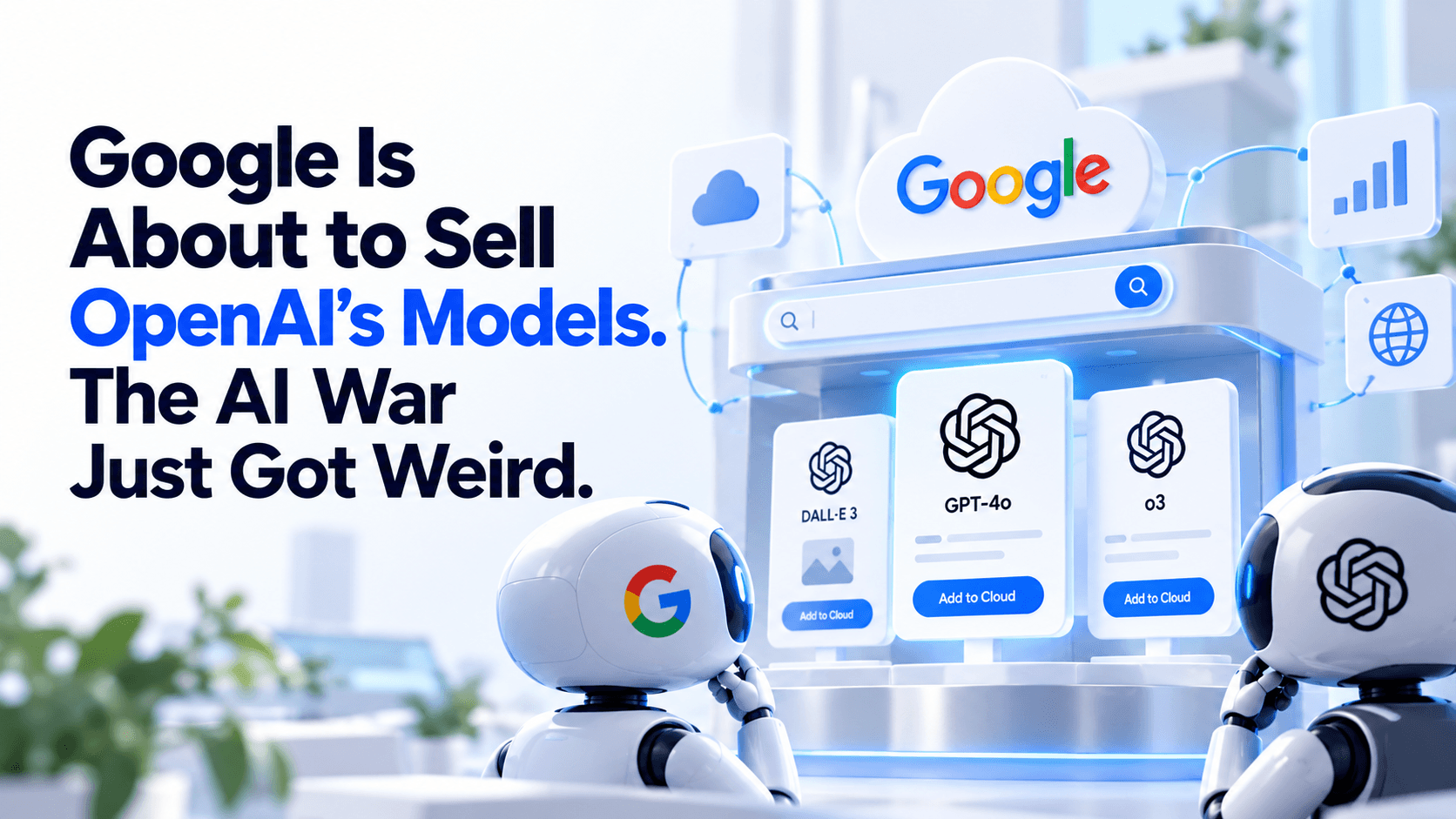
Google Is About to Sell OpenAI's Models. The AI War Just Got Weird.
OpenAI and Google compete for the future of AI, yet Google Cloud is preparing to offer OpenAI's frontier models and Codex. For businesses, the interesting part is model choice, cloud commitments and avoiding AI vendor lock-in.
Lynka Team · November 3, 2026 · 9 min read · AI
Follow Lynka on Google
Get new articles in your preferred sources.
On this page
Google makes Gemini.
OpenAI makes GPT.
They compete over models, developers, business customers, and how people use AI.
Naturally, Google is about to sell OpenAI's models.
Yes, that is a real announcement.
On October 21, 2026, OpenAI said its frontier models and Codex agentic workflows are coming to Google Cloud's Model Garden, with transactions through the Google Cloud Marketplace. General availability was planned for the coming weeks at the time of the announcement. Read OpenAI's announcement.
It sounds like the sort of partnership somebody would have suggested as a joke two years ago.
But it makes perfect business sense.
Google wants companies using Google Cloud, even when they choose somebody else's model.
OpenAI wants its models wherever companies already spend money and build software.
And customers increasingly want to stop rebuilding the whole system every time a new model wins a benchmark.
The model war is becoming a distribution war.
What exactly did OpenAI and Google announce?
The agreement will bring OpenAI's frontier models and Codex workflows into Google's cloud ecosystem.
According to OpenAI, the planned offer includes:
model access through Google Cloud Model Garden
purchasing through Google Cloud Marketplace
Google Cloud access controls and data governance infrastructure
the ability to use eligible existing Google Cloud spending commitments
planned access to OpenAI models through Google Antigravity and the Gemini Agent
If you are planning a production migration, don't treat a press announcement as proof that your specific model, region, quota or integration is live.
Check availability first.
Wait. Doesn't Google want businesses to use Gemini?
Of course.
It would be a very strange AI strategy if Google did not want people using Google's AI.
But Google Cloud has another business: selling infrastructure and becoming the place where enterprises run their technology.
Those two goals are not identical.
Imagine a customer says:
We already use Google Cloud for our data, governance and infrastructure. Our engineering team prefers OpenAI for this one task.
Google can respond in two ways.
Option A: Go build the OpenAI integration somewhere else.
Option B: Use OpenAI here, with the infrastructure and procurement systems you already have.
Option B is a much stronger cloud business strategy.
The cloud becomes the platform that helps you use whichever model works.
That is not Google conceding the model race.
It is Google making sure it can still win when its own model doesn't.
Why procurement matters more than developers think
AI comparisons usually focus on:
intelligence
latency
context length
pricing per token
benchmarks
Those are real considerations.
Inside an enterprise, a different set of questions can stop a project entirely.
Who approved this vendor?
Can we use our existing cloud contract?
Which identity controls apply?
Where are logs stored?
How is access reviewed?
Does the data governance policy cover this service?
Which team receives the invoice?
Developers dislike these questions because none of them improve the model's reasoning ability.
Finance and security teams love them because they determine whether the deployment can happen.
OpenAI says the agreement will let organizations purchase eligible models through Google Cloud Marketplace and draw down Google Cloud commitments. That detail is explicit in the announcement.
For a company already committed to substantial Google Cloud spending, that can change the purchasing decision.
Not because GPT suddenly gets smarter.
Because the invoice stops being an obstacle.
What is Google Cloud Model Garden?
Model Garden is Google's catalog for discovering and deploying AI models through Google Cloud's infrastructure and services.
The simple idea is to put more of the model selection and deployment workflow in one place.
A company might evaluate different providers for different tasks without replacing every surrounding application.
That sounds like a normal software-platform feature.
It is increasingly strategic because models change so quickly.
A company that hardcodes one model into every business process may regret it after the next price cut or release.
A company that can evaluate and replace components has more leverage.
What does this mean for GPT-6 Astra and Codex?
OpenAI's announcement refers to frontier models and Codex, while contemporary reporting identifies GPT-6 Astra among the important models expected through the cloud agreement. Reuters covered the planned distribution on October 21.
The more interesting development is Codex.
An AI model answers a request.
A coding agent may need to inspect repositories, run commands, read dependencies, propose changes, and validate results.
That is a workflow, not just a token endpoint.
Offering agentic coding in a cloud environment that businesses already govern could make the procurement and deployment story easier for large engineering teams.
But once again, the existence of an announcement is not a guarantee that all Codex features will have identical behavior or availability across products.
Check the exact integration before designing around it.
Google's Gemini agent makes this even more interesting
Two weeks earlier, Google introduced its own Gemini agent at Gemini at Work 2026.
Google described it as a universal assistant for knowledge work, coding and connected business systems, with skills, tools and enterprise controls. Google Cloud's announcement is here.
Then OpenAI announced that its models would also be coming to the Gemini Agent experience.
That is the shift.
The agent interface and the underlying model are becoming more separable.
You may use an interface built by one company while the model doing a particular task comes from another.
Eventually, the important product question may not be:
Which AI company's chat window are you using?
It may be:
Which system has access to your work, and how intelligently does it route tasks to the available models?
That creates an entirely different competitive landscape.
The risk: a very attractive new form of lock-in
There is a catch to every "one platform for everything" pitch.
It makes adoption easier.
It can also make leaving harder.
Once your:
identity
permissions
audit logs
model routing
agent workflows
data access
spending commitments
all run through one platform, switching becomes more than changing an API URL.
Even if you can switch models, you may become dependent on the cloud and orchestration layer.
So model freedom does not automatically mean infrastructure freedom.
Both levels matter.
How should a small SaaS company respond?
Most small companies do not need to migrate their AI workflows just because Google and OpenAI signed a partnership.
If your current integration works, keep it working.
The better lesson is architectural.
Build your application so changing a model is possible.
That doesn't require a grand enterprise platform.
It requires some discipline.
Separate business rules from model prompts
Lead qualification rules should not exist only as prose embedded in one model's system prompt.
Keep your business definitions explicit.
Keep your customer data in your own system
The model should operate on records you can audit and export.
Do not make a model provider's chat history your only customer database.
Measure cost per result
Token prices are useful, but outcomes matter more.
The cheaper model is not cheaper when every third answer requires a human correction.
Use fallback carefully
A second model can help when one fails.
But silently switching models may change writing style, structure and reliability.
Test it rather than assuming the same prompt behaves identically everywhere.
Keep permissions narrow
An AI agent doing account research does not need unrestricted billing or production access.
More model choice should not become more access than the task needs.
Should businesses choose Google Cloud to access OpenAI?
There isn't a universal answer.
A company already using Google Cloud deeply might gain procurement and governance advantages.
A small startup using the OpenAI API directly may gain very little by adding another layer.
A regulated organization might value centralized controls more than the shortest integration path.
A team working mostly inside another cloud might prefer its existing environment.
The actual decision depends on:
model availability in your region
contract terms
pricing and commitments
latency
governance needs
logging requirements
developer experience
reliability
Don't buy a more complex architecture because it looks impressive in a diagram.
OpenAI is expanding distribution, not announcing that Microsoft has disappeared from the picture.
That nuance matters because headlines about AI partnerships often make every new deal sound like a divorce.
Sometimes companies just want more customers.
What this means for CRM and business apps
For business software, the important part is less about clouds and more about architecture.
A CRM agent may have to:
inspect a company record
research public information
summarize a conversation
classify an opportunity
draft a next action
ask a human before sending it
Those steps do not all need the most expensive model.
The business logic should remain stable even if the AI component changes.
That's relevant to products like Lynka, where the important thing is the relationship between leads, deals and activities, not which model happens to word the next summary.
The agent can change.
The customer record should not.
The model is becoming a component
Think about payments.
A business doesn't rebuild its entire sales workflow because a payment provider changes its pricing.
Think about email.
A company shouldn't have to recreate the customer database because it changes email services.
AI is slowly moving toward a similar infrastructure role.
The model matters enormously for the task.
It should not own the entire product architecture.
Google and OpenAI are competitors.
Now they are also distribution partners.
The contradiction is useful because it reveals what the market really wants:
the ability to choose the intelligence without rebuilding the business around it.
That is the part worth watching after the launch headlines disappear.
OpenAI announced on October 21, 2026 that its frontier models and Codex workflows are coming to Google Cloud Model Garden. General availability was planned for the following weeks, so check current access and region before assuming it is live.
Contemporary coverage names GPT-6 Astra among the planned frontier models. Verify the exact model listing and availability in Google Cloud before implementing.
OpenAI says eligible enterprises will be able to buy through Google Cloud Marketplace and apply qualifying Google Cloud spending commitments.
OpenAI says its models are planned for Google Antigravity and the Gemini Agent, expanding model choice in Google's agent tools.
No. OpenAI explicitly says Microsoft remains its primary cloud partner.
Not necessarily. Switching models may become easier while infrastructure, data governance and agent orchestration still create platform dependencies.