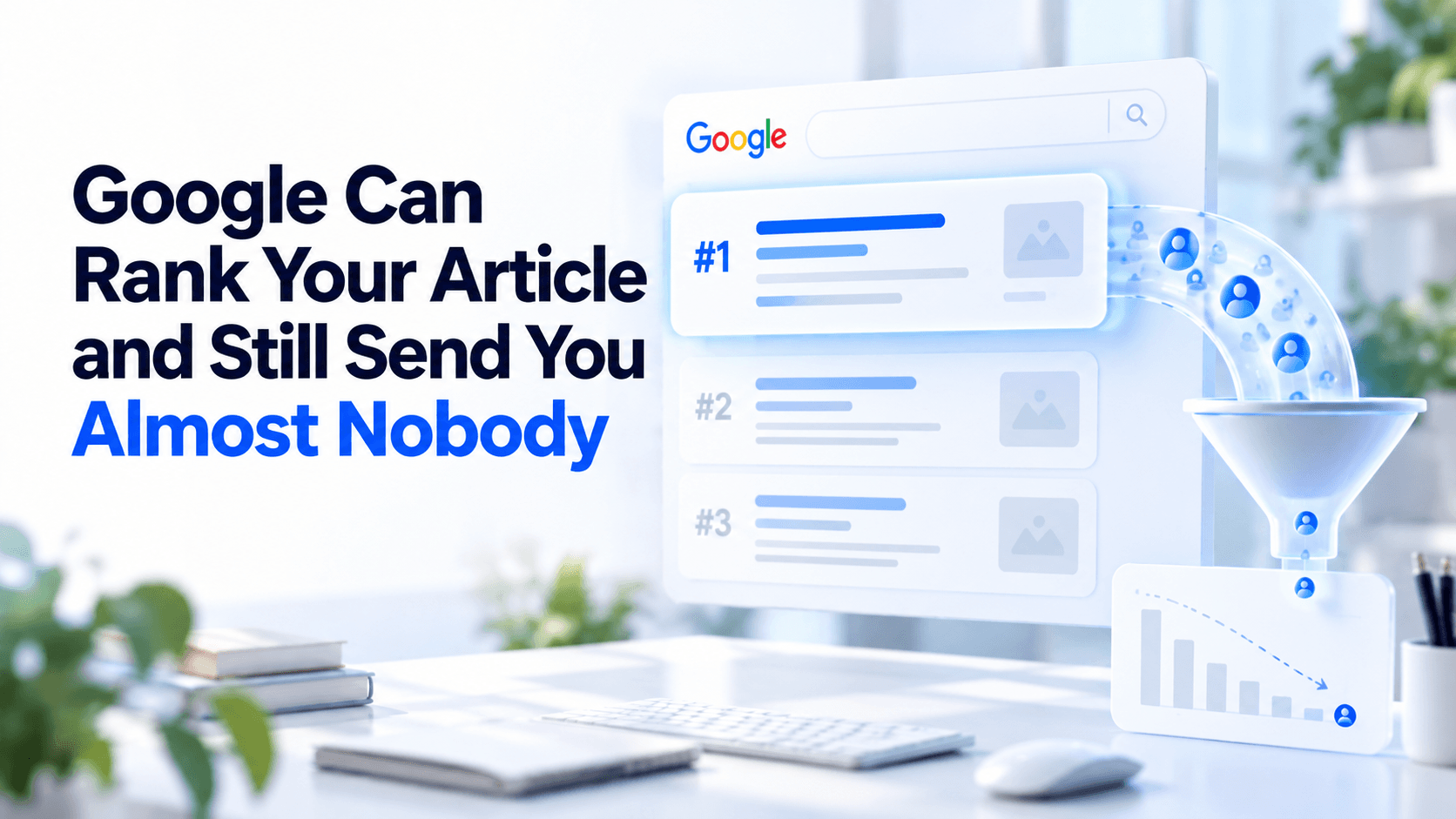
Google Can Rank Your Article and Still Send You Almost Nobody
AI Overviews can answer a question before anyone visits your site. That does not mean SEO is dead. It means publishers and small businesses need to stop confusing search impressions with readers, and start giving people a reason to click.
Lynka Team · October 28, 2026 · 13 min read · Marketing
Follow Lynka on Google
Get new articles in your preferred sources.
On this page
Imagine writing a genuinely useful article.
Google finds it.
Google indexes it.
Google shows it to people searching for the topic.
Google might even use its information to answer their question.
And almost nobody visits your website.
That is the increasingly uncomfortable world of AI search traffic.
On October 26, 2026, The Verge published a detailed look at the damage and dispute surrounding Google's AI-powered search features and the publishers that depend on referral traffic. Read the reporting.
The debate is bigger than one company complaining about fewer clicks.
It is a question about the old bargain of the web.
Publishers make useful content.
Search engines help people find it.
Some of those people visit the original website.
Now the search engine can increasingly give them the answer before they need to leave.
The awkward part?
Your SEO can technically work while your traffic doesn't.
What are AI Overviews and AI Mode?
Google's AI Overviews place generated summaries into certain search results. They can combine information from multiple sources and provide links to supporting pages.
AI Mode is a more conversational search experience where someone can ask follow-up questions rather than just review a traditional list of results.
The study also found that users clicked links inside the AI summary on about 1% of visits to pages with such summaries.
These are the results of a particular observed sample and period. They are not a universal click-through rate for every keyword or every country in 2026.
But the direction is difficult to ignore.
When the answer is already there, some people stop searching.
Which is exactly what a good answer is supposed to help them do.
That's the paradox.
Google disagrees with the bleakest interpretation
Google has pushed back on claims that AI Search is broadly destroying web traffic.
In its own August 2025 statement, Google said overall organic click volume from Search to websites was relatively stable year over year and argued that the quality of clicks was improving. Google's position is here.
That claim and Pew's study are not necessarily direct contradictions.
They measure different things.
One can observe lower clicking on pages that display summaries, while overall search behavior, query volume and traffic mix change in other ways.
The important point for an individual business is this:
A platform-wide average does not tell you what happened to your page.
Your article might gain traffic.
It might lose traffic.
It might receive more impressions and fewer clicks.
You need your own numbers.
The small website problem: impressions are not visitors
This is particularly painful for new SaaS websites and small publishers.
You open Search Console.
Your impressions went up.
That feels great.
You check clicks.
Almost nothing.
What happened?
Several possibilities:
you are appearing low on the results page
your title does not attract attention
search intent doesn't match the page
stronger competitors get the click
the searcher got enough information from the results page
an AI answer satisfied the question
the query is mostly informational and has low click intent
The trap is assuming every impression means Google almost sent you a customer.
It doesn't.
An impression means the page appeared in a search result under Google's reporting rules.
It is a visibility signal.
Not a visitor.
Not a lead.
Definitely not revenue.
Does this mean writing blogs is pointless?
No.
But it makes generic informational blogs a weaker strategy than they used to be.
Consider a page called:
What is a CRM?
If the article offers the same definition everyone else does, a search summary can satisfy much of the query without a visit.
Now consider:
Why Your Sales Team Has 300 Leads but Nobody Knows Who to Call
Or a page that contains:
a calculator
an original comparison
a useful template
detailed examples
verified current product information
a decision framework
interactive software
a practical walkthrough
Those provide reasons to go beyond the summary.
This does not guarantee traffic.
It creates something worth visiting.
That distinction matters more than article length.
Long content isn't automatically better content
SEO advice has an unfortunate habit of turning useful observations into arbitrary rules.
Detailed articles can perform well.
So someone decides every article must have 4,000 words.
Then you end up with:
What is a sales lead?
followed by a doctoral thesis, a history of selling, and a section about the origin of the word "lead."
The goal is to resolve the reader's actual question better than the search result already did.
The new question is: Why should someone click?
This is the question I would ask before publishing any article in 2026.
Imagine Google displays the first two paragraphs of your content as a summary.
Would the user still gain something by opening the page?
If not, the article might be too easy to replace.
Ways to make the visit valuable include:
Specific examples
Not "CRM improves efficiency."
Show how a lead moves from initial contact to qualification, deal and next action.
Original perspective
Take a position and support it.
For example:
The best CRM feature for a five-person team might be the one that stops them forgetting follow-ups, not the AI scoring dashboard.
That is more useful than repeating a vendor checklist.
Tools
A calculator or generator may solve a task more directly than an article describing how to do it.
Comparison with clear limits
If two products serve different customers, say so.
A trustworthy comparison may recommend the competitor.
Evidence and sources
For launch dates, pricing, API specifications or survey figures, link to real sources.
Not decorative citation bubbles that disappear when someone copies Markdown.
A clear next step
After answering the question, show the reader the useful action they can take.
Not a random CTA dropped into the last paragraph.
Search Console should guide what you write next
If you already have an established site, start with evidence from your own queries.
Look for:
Queries where Google already shows your pages.
Then ask:
Which existing URL is receiving the impressions?
Does it fully answer the intent?
Is the title clear?
Is another page competing for the same query?
Does the page provide a reason to visit?
Is there a useful tool, example or comparison missing?
A new blog post is not always the solution.
Sometimes the right action is improving the existing article.
Sometimes it is extending a tool page.
Sometimes the right action is doing nothing because the keyword has little business relevance.
Why keyword cannibalization matters
Suppose your site has:
/tools/sales-goal-calculator
Then you publish:
/blog/sales-goal-calculator
Then another:
/resources/how-to-calculate-sales-goals
All three try to own the same basic search intent.
Now the site has three mediocre answers competing with itself.
Better:
One primary URL owns the tool intent.
Supporting content links to it.
The content cluster makes sense to a human and to a crawler.
This is not a magic ranking trick.
It is avoiding unnecessary confusion.
What about optimizing for AI answers?
You will see terms like:
AEO
GEO
AI search optimization
Some of the underlying practices are useful.
But do not buy a mysterious service because it promises to make your brand "AI visible" using secret metadata.
Google's official guide says its generative search features still rely on core Search ranking and quality systems and that foundational SEO remains relevant. Read the Google Search guidance.
In plain English:
make the page crawlable and indexable
answer the actual query
keep information accurate
offer useful original material
use sensible titles and headings
connect related pages
maintain good page experience
avoid misleading structured data
There is no guaranteed prompt that makes Google's AI recommend your site.
Anyone selling that certainty deserves a little suspicion.
Why tools may become more valuable than definitions
An AI answer can explain how to calculate a sales target.
A calculator lets you enter your own numbers.
An AI answer can explain WhatsApp QR codes.
A QR generator produces the actual code.
An AI answer can summarize a lead-generation approach.
A working product helps manage the prospects afterward.
Those are different kinds of value.
Informational content helps people understand.
Interactive tools help people do.
For a small software company, the combination can be powerful.
That is why a useful free tool page can deserve more effort than ten generic blog posts.
Should you stop writing trending AI news?
No, but choose the news carefully.
A release article can capture fresh search demand before the results become crowded.
It can also become stale in 48 hours.
The best timely articles do two jobs:
explain what actually happened, with sources and dates
show why it matters to the reader in a way that remains useful after the headline fades
If an AI model launches, do not just repeat the benchmark table.
Explain the business economics, adoption constraints, and what a team should test.
That gives the article a longer shelf life than a launch summary.
What to measure besides clicks
Traffic still matters.
But it should connect to something.
For a SaaS website, useful measures include:
Signal
What it tells you
Search impressions
Google is testing visibility for a query
Organic clicks
People reached the website
Click-through rate
Searchers chose the result at the positions shown
Engaged visits
Readers found enough value to continue
Tool use
Someone did something useful
Pricing/product visits
The content generated commercial interest
Signups and qualified enquiries
Interest became a business opportunity
There is no point celebrating 20,000 low-intent impressions if none of the readers care about your product.
There is also no reason to panic over a low CTR without checking average position and query intent.
A page ranking far down the results normally gets fewer clicks.
AI answers are one variable, not an excuse for every SEO problem.
Own a relationship outside Google
This is the uncomfortable but useful lesson from the publishing industry's struggle.
If all your discovery depends on a platform you do not control, that platform can change the terms.
You do not need to abandon Google.
You do need other ways for people to remember you.
For a business, that could include:
a useful newsletter people actually want
original research others refer to
a product people return to
free tools with real utility
direct customer relationships
thoughtful social distribution
documentation that solves practical problems
The objective is not to become an influencer.
It is to stop every new visitor being someone you have to reacquire from scratch.
What this means for Lynka
A small CRM company should not try to become a general encyclopedia of AI.
The relevant questions are the ones connected to customers, sales, lead generation, invoicing, and running a small business.
An article about a model release makes sense when we can explain what it changes for actual work.
A sales-goal calculator makes sense because a person has a calculation to complete.
A guide about lead follow-up makes sense because people lose real opportunities that way.
And when a reader wants to move from theory to doing, Lynka Sales, Lead Generation and the site's tools should be easy to discover.
The blog is not the product.
It's one of the ways people discover why the product exists.
An honest content strategy for 2026
If I were running a small SaaS website today, I would divide content work into three parts.
Improve proven pages
Look at Search Console queries that already show impressions.
Repair weak titles, missing explanations, unclear examples and mismatched intent.
Do not create a duplicate article because an existing page needs work.
Publish selective new articles
Choose topics with:
real search demand or a genuinely fresh development
relevance to the audience
enough substance for a useful original take
a natural next step into the site
No random content calendar filler.
Invest in things AI cannot simply summarize away
Practical tools.
Good documentation.
Current comparisons.
Interactive examples.
Strong product pages.
A reason to return.
That is how a content site becomes something more than a source for someone else's answer box.
The ugly part of AI Search
Google's job is to answer the searcher's question.
Your job is to create something worth visiting.
Those goals used to align more neatly.
Now they sometimes compete.
That isn't fixed by writing more words, buying a new SEO acronym, or adding a little robot icon beside your article title.
It is fixed, as far as any business can fix it, by creating value that survives the summary.
Google can rank your article and still send you almost nobody.
So give the reader a reason to want more than the answer.
A Pew Research Center study of March 2025 browsing activity found fewer traditional search-result clicks on observed pages with AI summaries than on pages without them. Results vary by query, market, ranking and time period.
No. Google says its AI search features still build on core Search indexing and ranking systems. Good technical SEO, useful content and accurate information remain important.
Possible reasons include average ranking position, search intent, title appeal, competing results, AI summaries and other features of the search results page. Inspect individual queries and pages before drawing conclusions.
Original insight, practical tools, current evidence, interactive material, comparisons and task-completion pages can give people reasons to visit beyond reading a short summary. None is a guarantee.
No. Group related queries by search intent and give one strong URL ownership of each topic. Improve an existing page when it already serves the intent.
No. Structured data can help explain a page, but it does not guarantee search features or citations in AI answers.
No. Preferred Sources is a user preference feature, not a general-purpose guaranteed ranking boost for every searcher.
Google SearchAI OverviewsSEOAI SearchWebsite TrafficContent MarketingSearch Console
Keep the next step connected
Find leads and manage them in one place with Lynka.
Bring prospecting, follow-up, sales and the work after the sale into one connected workspace.