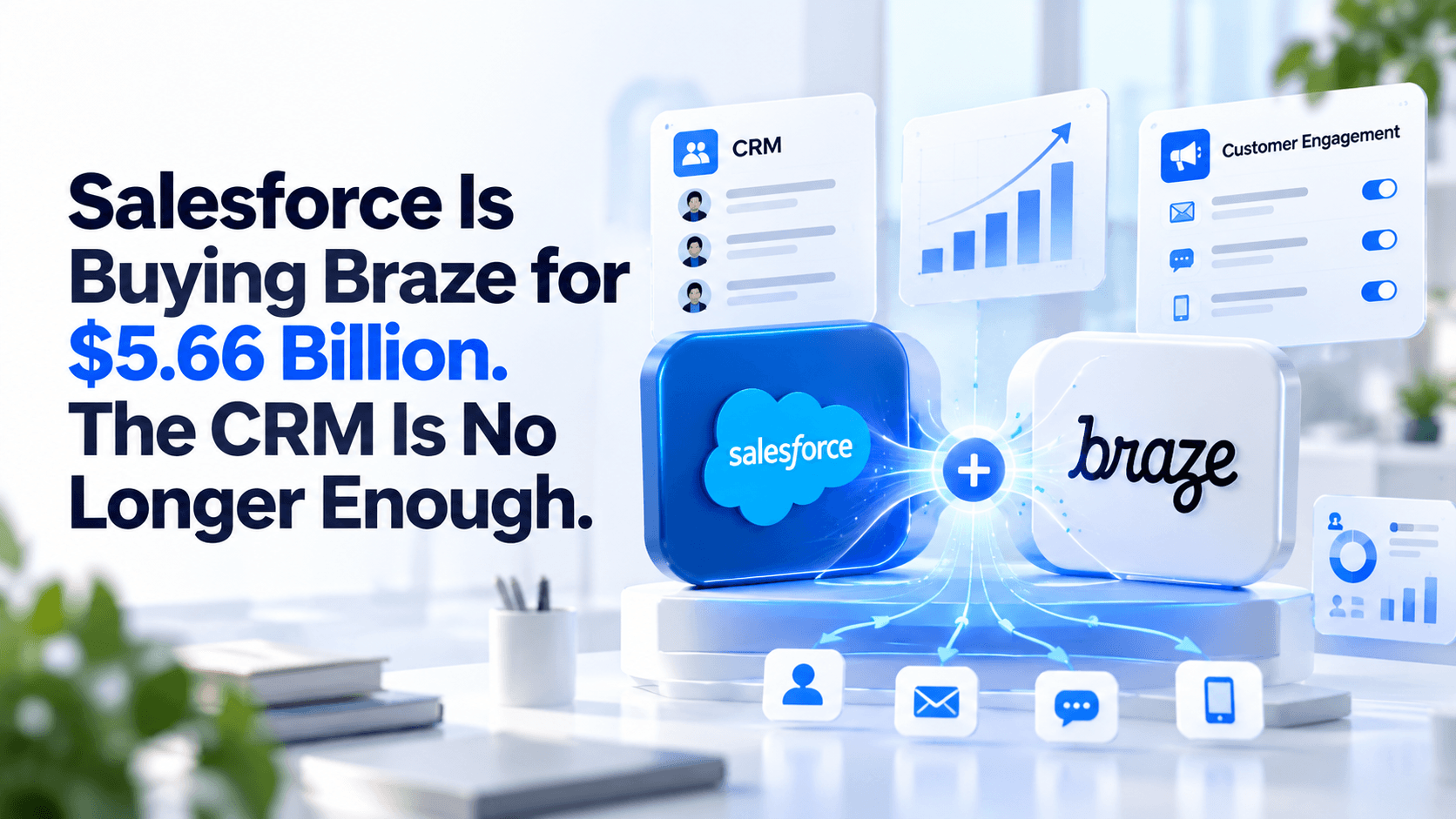
Salesforce Is Buying Braze for $5.66 Billion. The CRM Is No Longer Enough.
Salesforce agreed to acquire Braze for about $5.66 billion. The important part isn't another software acquisition. It's the race to connect customer data with what actually happens after someone opens an email, visits a site, or makes a purchase.
Lynka Team · October 29, 2026 · 9 min read · CRM
Follow Lynka on Google
Get new articles in your preferred sources.
On this page
Salesforce has agreed to buy Braze for approximately $5.66 billion.
A perfectly normal amount of money to spend on making sure the right customer gets the right message.
The deal was announced on October 20, 2026. Salesforce says Braze shareholders will receive $47.50 per Class A share in cash, and the acquisition is expected to close in Salesforce's fiscal 2028, subject to shareholder and regulatory approvals. So, to be precise, Salesforce has agreed to acquire Braze. The deal has not already closed. .
Braze is designed to help businesses decide what to do with that knowledge right now.
That gap is becoming the entire software industry.
What is Braze, and why would Salesforce want it?
Braze is a customer engagement platform focused on responding to what people do across digital channels.
Think email, SMS, mobile push, in-app messages, websites, and messaging platforms such as WhatsApp.
The key concept is behavioral context.
A person browses a product.
Leaves without purchasing.
Returns the next day.
Adds something to their cart.
Opens the app again.
A modern engagement platform tries to interpret those events and choose the right next message or experience.
Not because someone manually added the customer to a list called Campaign 14 Final v2.
Because their behavior changed.
Salesforce says Braze serves about 2,770 customers and handles very large volumes of cross-channel engagement. It cites brands including Canva, Instacart, Equinox, and Venmo. See Salesforce's deal rationale and customer information.
That is not a tiny email plugin being added to an existing product.
It's a serious effort to own more of the customer lifecycle.
CRM used to mean storing the relationship
The traditional CRM story is familiar.
Customer record.
Contact details.
Deal.
Salesperson.
Notes.
Next follow-up.
That's all useful. It still leaves a problem.
A customer relationship doesn't stop happening because nobody updated a CRM field.
People browse.
Click.
Open emails.
Use products.
Ask for help.
Ignore messages.
Come back months later.
Much of that behavior historically lived in marketing, product analytics, support, and billing systems outside the sales database.
The CRM said:
This is customer Sarah.
The marketing tool said:
Sarah abandoned a cart 17 minutes ago.
The support tool said:
Sarah is furious about a missing delivery.
And the campaign system said:
Send Sarah our cheerful promotional discount.
Absolutely perfect timing.
The acquisition is about making that separation harder to tolerate.
What Salesforce says the combined platform will do
Salesforce says Braze's engagement engine is expected to complement several parts of its platform, including Data 360, Customer 360, Agentforce, and its broader AI architecture.
Its proposed benefits are fairly specific:
act on customer behavior in real time
coordinate messages and experiences across channels
personalize content, offers, timing and delivery
connect marketing decisions to more of the customer relationship
That distinction matters because acquisitions are often easiest to announce and hardest to integrate.
The bigger trend: sales, marketing and service are merging
Software used to divide work into neat departments.
Marketing generated the lead.
Sales closed the deal.
Support handled the problem.
Finance chased payment.
That organizational chart makes sense inside a company.
It makes less sense from the customer's side.
A customer is not thinking:
My question now officially belongs to Customer Success rather than Marketing Operations.
They think:
Does this company understand what is happening?
A connected system should know whether:
the customer just bought
there is an open support complaint
the invoice is overdue
a product was returned
the deal is still being negotiated
the customer has already opted out of outreach
And then avoid doing something stupid.
This is the commercial logic behind the acquisition.
Real-time personalization sounds great until it gets creepy
There is an uncomfortable side to all this.
The more a company knows about behavior, the more precisely it can act.
That might mean a helpful reminder.
It might also mean a notification sent because someone spent four seconds looking at the wrong page.
Customers do not experience all personalization as helpful.
Some experience it as surveillance with nicer typography.
The difference often comes down to:
relevance, timing, consent, and restraint.
If a customer has an unresolved complaint, do not send a cheerful upsell.
If they already purchased the product, stop retargeting them as if they never did.
If they told you to stop messaging, stop.
If they visited your pricing page once, that does not automatically mean they want seven emails.
A sophisticated engagement engine can execute a bad decision much more efficiently than a person.
Why AI makes this acquisition more interesting
There is another layer.
Traditional marketing automation follows predefined rules.
If event A happens, wait 24 hours, then send message B.
AI decisioning promises something more flexible:
Given this customer's context and behavior, what is the most appropriate next action?
Braze has been building its own AI-driven engagement capabilities. Salesforce wants those decisions tied to a broader view of the customer and its agent platform.
That is potentially powerful.
It also raises the bar for data quality and governance.
An agent can't make a good next-action decision if the customer identity is duplicated, the purchase event arrived late, or the consent status is wrong.
This is where the boring plumbing becomes more important than the model.
Does every small business need Braze-level complexity?
No.
And pretending otherwise would miss the lesson completely.
A bakery with two staff members probably does not need real-time cross-channel personalization infrastructure.
An agency with 40 active clients may need something simpler:
a record for each client
one place for open opportunities
follow-up reminders
clear campaign source
email history where available
quotes and invoices connected to the relationship
That's already a meaningful improvement over five spreadsheets and a collection of forgotten WhatsApp chats.
The important lesson from a multibillion-dollar acquisition is not that every company should buy a multibillion-dollar architecture.
It's that customer context should not get lost between tools.
Customer data is not the same as customer understanding
This sounds philosophical, but it is operational.
Imagine your database contains:
Contact: Daniel
Last campaign open: yesterday
Last sale: two years ago
Current deal: stalled
Support ticket: unresolved
A system has the data.
Does the business understand the relationship?
Not unless it can answer:
What should we do next?
Probably resolve the support problem before sending Daniel a new product promotion.
That sounds obvious to a human who sees everything in one place.
It is not obvious to four disconnected applications.
What an integrated workflow should actually look like
Take a small B2B services company.
Someone downloads a guide.
They ask for pricing.
Sales qualifies them.
A proposal is sent.
They become a customer.
An invoice is issued.
A support issue appears.
They eventually renew.
The ideal system preserves the history across these events without forcing the same person to be recreated in every tool.
Even if the software remains separate, the identity and state should be connected.
That is a better design goal than collecting more features.
Five questions businesses should ask their CRM vendor
1. Which system owns the customer identity?
If someone appears in your CRM, billing system, and email platform, how are those records matched?
2. What happens when a customer changes status?
Does a closed deal update what other teams can see? Does an unsubscribe stop messages?
3. Can you see why a message was sent?
"The automation did it" is not an explanation.
4. Can a person intervene?
Can an employee stop a journey before it reaches the wrong customer?
5. What does the reporting show?
Not only message opens. Show qualified opportunities, customers and meaningful business outcomes.
If a platform cannot answer these questions, the problem may be workflow design rather than feature count.
What this means for smaller CRM companies
Salesforce buying Braze does not mean small CRM companies should immediately clone Braze.
That would be an expensive misunderstanding.
It means the old line between database of customers and system that helps manage customer relationships is getting thinner.
Small businesses increasingly want the practical pieces connected:
That's already the direction Lynka takes with Sales and its connected commercial workflow.
It is not Braze's replacement, nor a claim to have its enterprise engagement engine.
It is the same underlying customer problem at a much smaller, more practical scale.
What happens next with the acquisition?
There are real uncertainties.
As of October 26, 2026, this is a signed agreement, not a completed merger.
The transaction still needs approvals. Product integrations, packaging, possible changes to pricing, and the future experience for customers should not be presented as finished facts.
Existing Braze customers should watch official communications, contractual terms and product roadmaps rather than assume everything changes tomorrow.
Salesforce announced a definitive agreement to acquire Braze on October 20, 2026. As of October 26, the acquisition has not yet closed.
The announced enterprise value is approximately $5.66 billion, with $47.50 in cash for each Braze Class A share under the agreement.
Braze is a customer engagement platform that coordinates communications and experiences across channels using behavioral signals, customer context and AI-driven decisioning.
Salesforce says Braze would strengthen real-time engagement and personalization alongside its CRM, data platform and AI agents.
Salesforce expects Braze to complement Marketing Cloud and other platform components, but the final integration and packaging details are not yet fully determined.
Not necessarily. Small businesses should prioritize reliable customer records, follow-up, useful integrations and clear sales outcomes rather than feature consolidation for its own sake.