ChatGPT Ads Are Now in 89 Countries. Is This Where Your Next Customer Comes From?
OpenAI says more than 100,000 advertisers have tried ChatGPT Ads and availability has expanded to 89 countries. But a conversation is not a conversion, and small businesses should think carefully before moving budget away from channels they can already measure.
Lynka Team · November 3, 2026 · 10 min read · Marketing
Follow Lynka on Google
Get new articles in your preferred sources.
On this page
For years, the small-business marketing playbook was predictable.
Google finds someone already looking.
Facebook and Instagram put you in front of people who might care.
Email follows up.
Your CRM tries to remember the rest.
Now there's another place trying to enter that budget conversation:
ChatGPT.
On October 21, 2026, OpenAI announced that ChatGPT Ads had expanded into , bringing availability to . OpenAI also says have already run campaigns on the platform. .
It is not enough to assume your next campaign should run there.
Because this is the question businesses should ask before buying any new advertising product:
Does this bring customers, or does it just bring a new dashboard?
What are ChatGPT Ads?
ChatGPT Ads are sponsored placements shown separately from the assistant's responses in eligible ChatGPT experiences.
OpenAI says they are clearly labeled and do not influence the answers the assistant gives. It also says advertisers do not receive private ChatGPT conversations and customer data is not sold to advertisers. The October expansion announcement explains those principles.
That distinction is important.
This is advertising around a conversation, not a brand secretly rewriting the assistant's answer.
From the advertiser's perspective, the attraction is obvious.
Someone is not merely scrolling past content.
They may be actively working through a decision:
Which accounting software is suitable for a five-person consulting agency?
Or:
How do I find leads for a new cleaning business?
Or:
What's a good way to manage sales follow-up without hiring another employee?
Those are commercially interesting moments.
The challenge is figuring out whether your ad helped the person decide, or whether it was simply present nearby.
What changed on October 21?
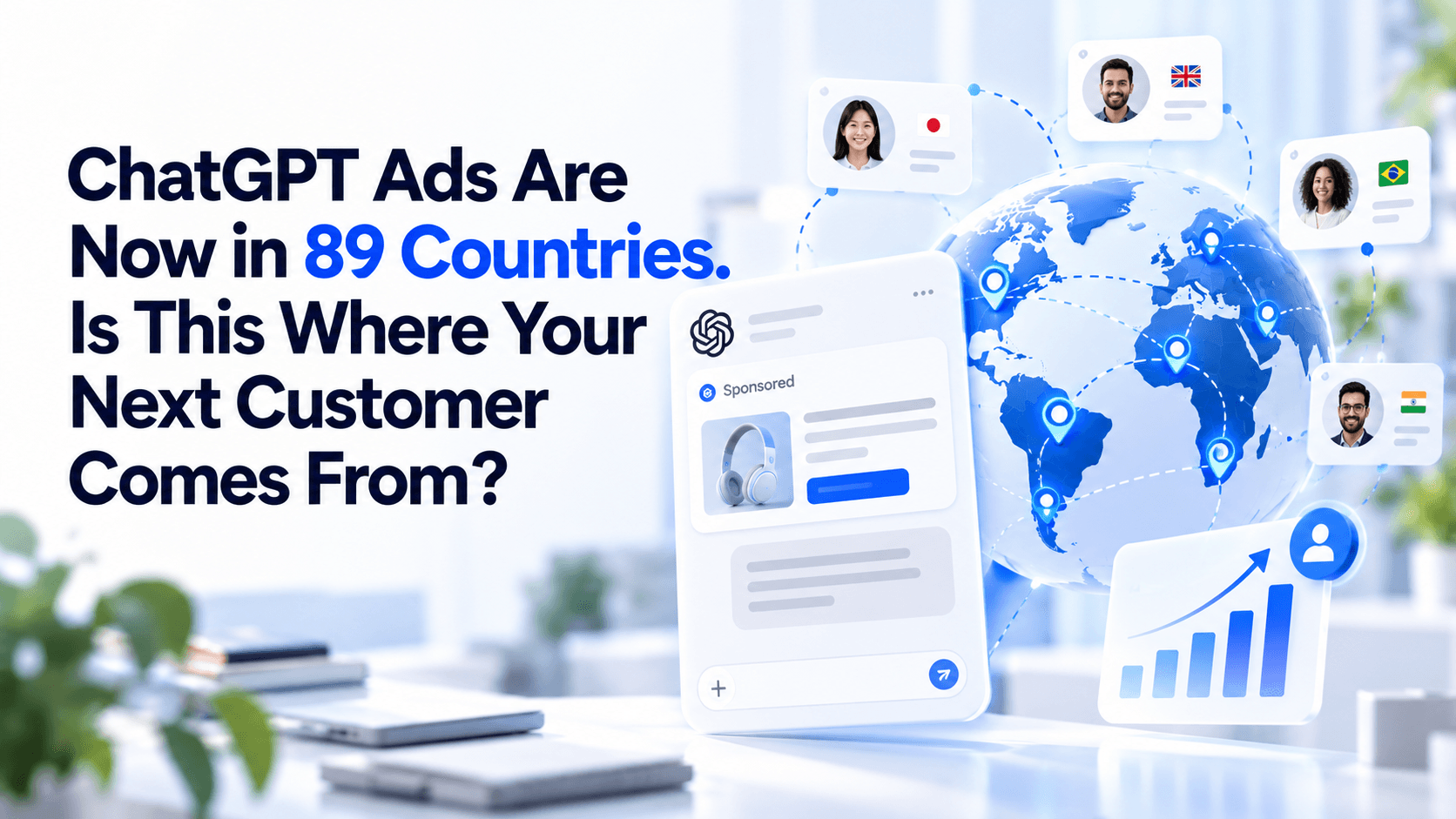
OpenAI says the platform is now available in 89 countries after adding 26 more.
The new rollout included countries across Latin America, Europe, the Middle East, Africa and Asia. OpenAI specifically mentioned markets including Nigeria, South Africa, Argentina, Chile, Colombia, Peru, Serbia, Ukraine, Cambodia, Bangladesh and Pakistan. See the official geographic announcement.
That is a major expansion of its advertising footprint.
But do not assume every country is included just because the map looks broad.
Check your own market and account eligibility through ChatGPT Ads before writing a campaign plan.
89 countries is not the same as every country.
Who actually sees ChatGPT ads?
According to OpenAI, ads are shown only on the Free and Go plans. Paid plans such as Plus, Pro and Enterprise remain ad-free in the stated rollout. OpenAI describes plan eligibility here.
That creates an interesting audience question.
A marketer might imagine advertising to every executive using an AI assistant for research.
But the audience that sees ads is determined by the supported plans and placements, not simply by how many total people use ChatGPT.
OpenAI says more than 1.2 billion people use ChatGPT weekly. That is a platform-wide figure, not a statement that 1.2 billion users see ads or that all of them are in an advertiser's target market.
Those are very different numbers.
Do not confuse total product reach with addressable advertising inventory.
Why advertisers are interested
Traditional search ads often appear beside a short query.
For example:
CRM software
ChatGPT conversations can reveal a much more detailed commercial problem to the system:
I'm running a three-person business, I already use Gmail and spreadsheets, and I'm looking for something that manages deals and invoices without Salesforce complexity.
That sounds attractive for relevance.
But remember the privacy boundary: advertisers are not supposed to receive the private conversation itself.
What businesses are buying is an advertising opportunity in an environment where people may be exploring decisions, not the right to inspect what every user said.
That's a distinction worth understanding before somebody sells you "hyper-personalized conversational leads."
A conversation is not necessarily buying intent
People ask ChatGPT about everything.
Health questions.
Homework.
Stories.
Research.
Career decisions.
Products they will never buy.
Pricing for services in countries they do not live in.
The presence of a commercial word in a question does not prove the person is ready to purchase.
This is not a flaw in ChatGPT Ads.
It is simply the normal problem of marketing dressed in a new interface.
A good campaign still needs:
an appropriate audience
a real problem
a relevant offer
a trustworthy destination
an easy next step
conversion tracking
follow-up
You cannot skip those steps because the placement happens inside AI.
ChatGPT Ads vs Google Ads
These channels do not necessarily replace each other.
Question
Google Search Ads
ChatGPT Ads
Typical user action
Search for information or an option
Explore a problem through conversation
Commercial signal
Search terms and context
Relevant conversational context within platform rules
Advertiser control
Mature campaign and keyword ecosystem
Newer product with evolving formats and measurement
Main risk
Expensive competitive keywords
Uncertain economics and changing inventory
Best test
Track qualified outcomes
Track qualified outcomes
Google search ads are not magically better because they are old.
ChatGPT ads are not magically better because they are new.
Run the same economic test.
What about Sponsored Agents?
This is where the format gets more interesting.
In September 2026, OpenAI announced experiments with Sponsored Agents, which let people choose to open a conversation with a business-sponsored AI representative after interacting with an ad. OpenAI also announced HubSpot and Shopify integrations tied to its advertising expansion. See OpenAI's Sponsored Agents announcement.
But here is the caveat most excited articles omit:
Sponsored Agents are not generally available to all advertisers.
OpenAI's current help documentation describes them as a limited alpha for selected advertisers, with no open early-access request process at the time documented. The availability FAQ is here.
Do not build your October acquisition strategy around a format you cannot currently buy.
The future looks like a sales conversation before the sales call
Imagine someone exploring a CRM.
They ask:
Can it handle leads and invoices?
A sponsored business representative could eventually explain the product, answer basic questions and perhaps help the person take a next step.
That is more useful than a generic banner saying:
TRANSFORM YOUR BUSINESS TODAY.
But it creates new responsibilities.
The sponsored agent should know what the business actually offers.
It should not invent features.
It should not promise discounts that do not exist.
It should not pretend to be an independent recommendation.
And it should make it obvious when the user is interacting with advertising rather than a neutral assistant response.
The difference between a helpful sales representative and a hallucinating advertisement matters quite a lot.
What would make ChatGPT Ads good for a small business?
Not the size of the audience.
The ability to reach a relevant buyer at an acceptable acquisition cost.
A local service business might care about:
geography
service need
qualified enquiries
booked jobs
A B2B software company might care about:
qualified trials
demos
paid conversions
business size
actual customer fit
If all you measure is clicks, the new platform will look exciting almost regardless of business impact.
The experiment I would run first
Do not move your entire Google or Meta budget into ChatGPT because you read a headline.
Start with a bounded test, when the channel and buying options are available to you.
Step 1: Choose one problem
For Lynka, for example, the problem might be:
I need to find prospects and manage sales follow-ups without juggling five tools.
Not:
CRM for everyone.
Step 2: Send people to a specific page
A general homepage may be fine for broad brand discovery.
For a focused lead-generation experiment, the destination should match the promise.
Businesses should respect that distinction rather than try to blur it.
Your ad can be persuasive.
It should not pretend to be the assistant speaking.
What this means for SEO and content
This is where small businesses should pay attention even if they never buy a ChatGPT ad.
Product discovery is spreading across:
traditional Google Search
AI search answers
conversational assistants
social communities
advertising inside AI tools
referrals and direct traffic
That means your website still needs to explain the product clearly.
What does it do?
Who is it for?
What does it cost?
What does it not do?
Why should someone trust it?
If those answers are missing from the website, paid AI distribution doesn't fix the problem.
It just sends the confusion to more people.
The boring CRM part that matters most
Suppose ChatGPT Ads generates ten enquiries.
One is spam.
Three are poor fits.
Two are interested but not ready.
Four could become customers.
What happens now?
Who contacts them?
Who qualifies them?
Where are the conversations recorded?
Who follows up next week?
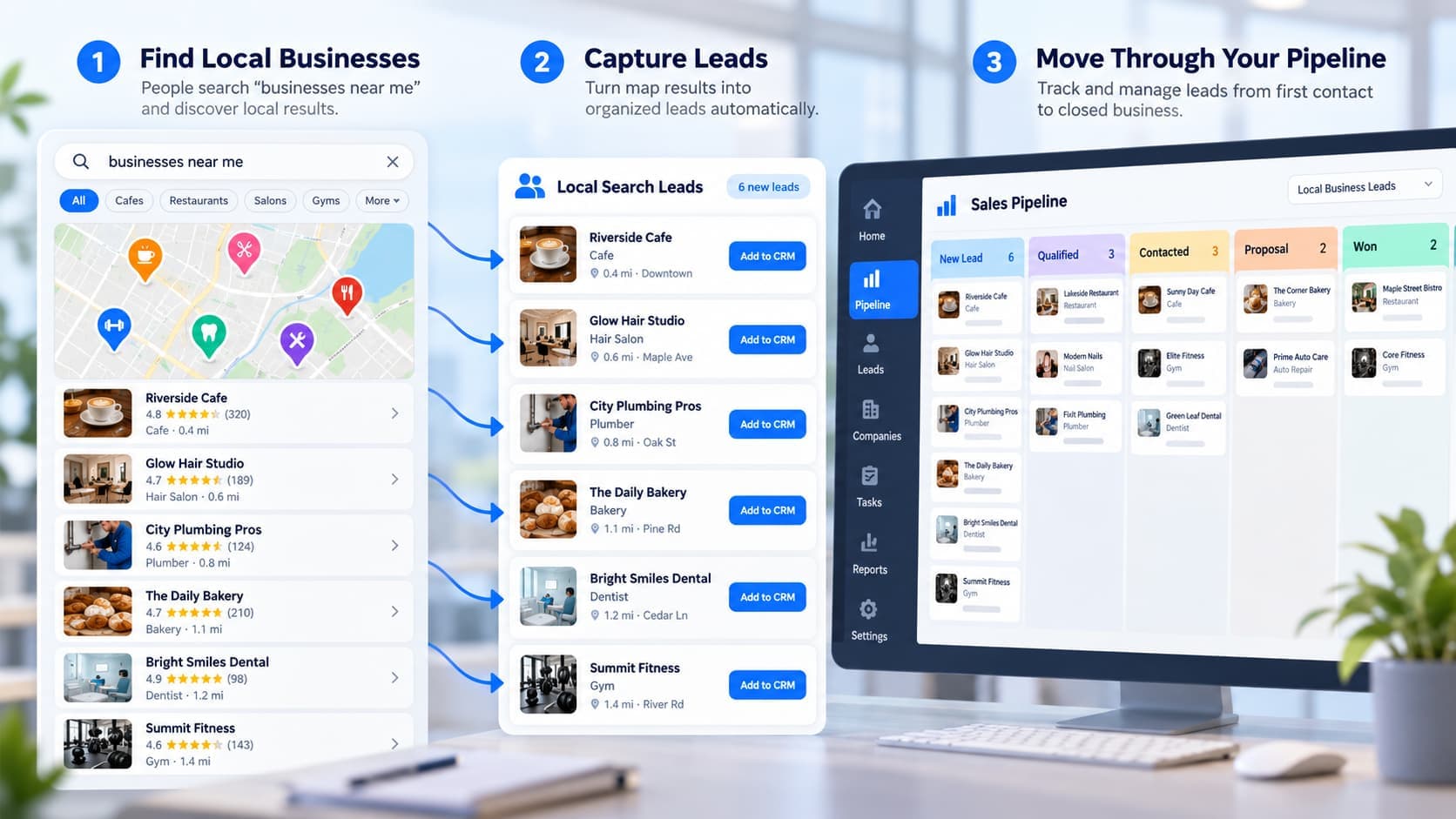
That is why lead generation and CRM should be connected. Lynka's sales workflow and lead generation address the part after discovery, where interest either becomes a relationship or gets forgotten.
New advertising channels do not eliminate the old operational problem.
They send more people into it.
Should small businesses advertise on ChatGPT now?
If your market is supported, your offer is clear and you can measure real outcomes, it may be worth testing.
If you have no idea which of your existing leads become customers, I would fix that first.
The world's newest ad platform cannot repair a broken sales process.
Also, don't assume all formats are available to you. Standard advertising and experimental Sponsored Agents have different access rules.
For current access, start with ChatGPT Ads, not somebody's screenshot.
The actual opportunity
The internet has spent years teaching businesses to compete for clicks.
AI interfaces may move more of the buying journey into conversations.
That could be valuable.
But an interesting conversation is still not revenue.
The winners will be the businesses that connect discovery to a useful customer experience, then follow through after the first interaction.
OpenAI announced on October 21, 2026 that ChatGPT Ads expanded to 89 countries after adding 26 markets. Check the current supported-country list for your location.
OpenAI says more than 100,000 advertisers have run campaigns on the platform since its launch.
OpenAI says ads appear on Free and Go plans, while Plus, Pro and Enterprise plans remain ad-free under the announced rollout.
OpenAI says advertisers cannot access private user conversations, and it does not sell user data to advertisers.
They are an experimental format allowing users to converse with a sponsored business agent after opening one from an ad. The format is currently limited to selected advertisers.
Not automatically. Compare qualified leads, acquisition costs and conversion outcomes before reallocating meaningful budget.
OpenAI offers access through partners or its Ads Manager in supported markets, but exact eligibility, format availability and account setup can vary.